Source Separation: The First Step Toward Better Recycling
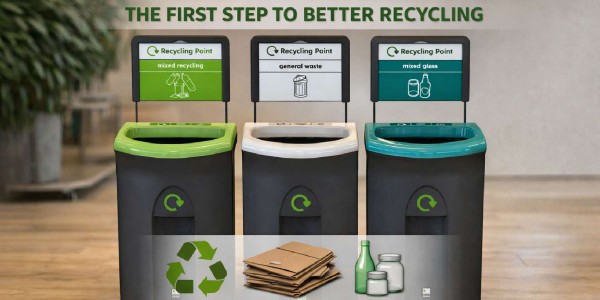
Source separation is the practice of sorting waste at the point where it is generated, before different materials become mixed together. In simple terms, paper, plastic, glass, metal, organic waste and other waste streams are collected separately from the start. This is exactly what makes recycling more effective, because materials stay cleaner and more suitable for reuse, recycling or biological treatment. The European Commission’s guidance on separate collection highlights that this approach improves both the quantity and the quality of materials that can be recovered.
For businesses, municipalities, schools, hotels and public facilities, source separation is no longer just a sustainability trend. It is a practical way to organise waste management more efficiently, improve cleanliness, reduce contamination between waste streams and create a system that people can actually follow in everyday use. According to the European Environment Agency, effective separate collection of bio-waste is especially important because bio-waste is the single largest waste component in municipal waste, and better collection systems are directly linked to higher recycling performance.
In practice, a successful source separation system depends on one key factor: using the right bin in the right place. Even the best recycling policy will underperform if the collection points are confusing, inconvenient or poorly adapted to the space. Ease of use, hygiene, accessibility and clear daily routine are all important in helping people participate consistently. Convenience at the point of disposal is one of the main factors that improves participation in separate collection systems.
This is where ECOVRS can add real value. The company’s product range includes dedicated solutions for home use, small internal sorting stations, plastic recycling bins, metal recycling bins, wheeled bins and green-point style collection solutions, allowing each project to be adapted to its actual use and user profile.
For office interiors, receptions, corridors and narrow internal spaces, the Meridian Recycling Bin is a strong choice. On the ECOVRS site, Meridian is presented as a bin that combines an 87 L or 110 L capacity with a slim design that fits comfortably in tight spaces without compromising access. This makes it especially suitable for modern workplaces where appearance, footprint and practical use all matter.
When the goal is to create a clear and professional recycling station indoors, the Envirobin HUB range is one of the most useful options. ECOVRS presents the 2-stream, 3-stream and 4-stream HUB versions as ideal solutions for creating a dedicated recycling corner. This makes them a good fit for office floors, schools, universities, common areas and any facility where users need an intuitive multi-stream collection point in one location.
For shared-use spaces and higher-traffic internal areas, the TwinBin Recycling Bin is a very practical option. According to the product page, one unit collects two separate waste streams, using two 85 L liners for a total capacity of 170 L. Its reinforced double-wall structure, front-opening design for easier emptying and customisation potential make it a smart solution for common areas that require durability and ease of servicing.
For schools, educational environments and spaces where recycling needs to be made more approachable, ECOVRS also offers more user-friendly and visually distinctive options. The Hippo Recycling Bin is one example already featured on the site, while the broader plastic recycling bins category also includes solutions such as MiniBuddy, Pencil, Smiley and other education-oriented models designed for child-friendly environments. These products can help turn source separation into a visible and engaging daily habit rather than just another disposal point.
For projects that require multi-stream separation with a stronger architectural or premium design character, the Cervic range is particularly relevant. ECOVRS explains that Cervic bins are designed according to the needs of different environments such as airports, museums, shopping centres, universities, corporate spaces and restaurants. A strong example is the Manchester model, which is available for 2, 3, 4 or 5 waste streams, with capacities ranging from 120 L to 300 L depending on the configuration.
If the project includes organic waste collection, source separation should begin at the household or user level with the right small collection tool. The Kitchen Caddy for Municipal Bio-waste Programs on the ECOVRS site is presented as the first and most critical step for clean source separation of organics. The page highlights practical benefits such as easier daily use, reduced contamination, improved household hygiene and suitability for municipal distribution programs. It is available in multiple capacities and in ventilated or non-ventilated versions, depending on the collection logic of the program.
In short, source separation is not only about recycling more. It is about designing a system that is easier to use, easier to maintain and more effective in real everyday conditions. With the right equipment, waste streams stay cleaner, users participate more consistently and the entire waste management process becomes more structured and more efficient. For ECOVRS customers, that means selecting bins not just by size, but by function, environment and user behavior. When that happens, source separation becomes a practical operational tool, not just an environmental message.
Latest Posts
-
SolarStreetBin in Galway Ireland
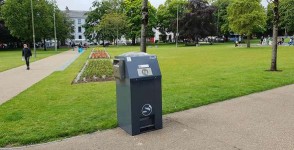
Galway City Council in Ireland installs solar powered litter bins.
-
EcoVRS in FODSA in Kalamata
Annual Waste Management Meet-up.
-
Participation in the Environmental Expo Verde Tec 15-17/2
ECOVRS is participating in Verde.Tec 2019 introducing new products and technologies for municipalities and companies.